
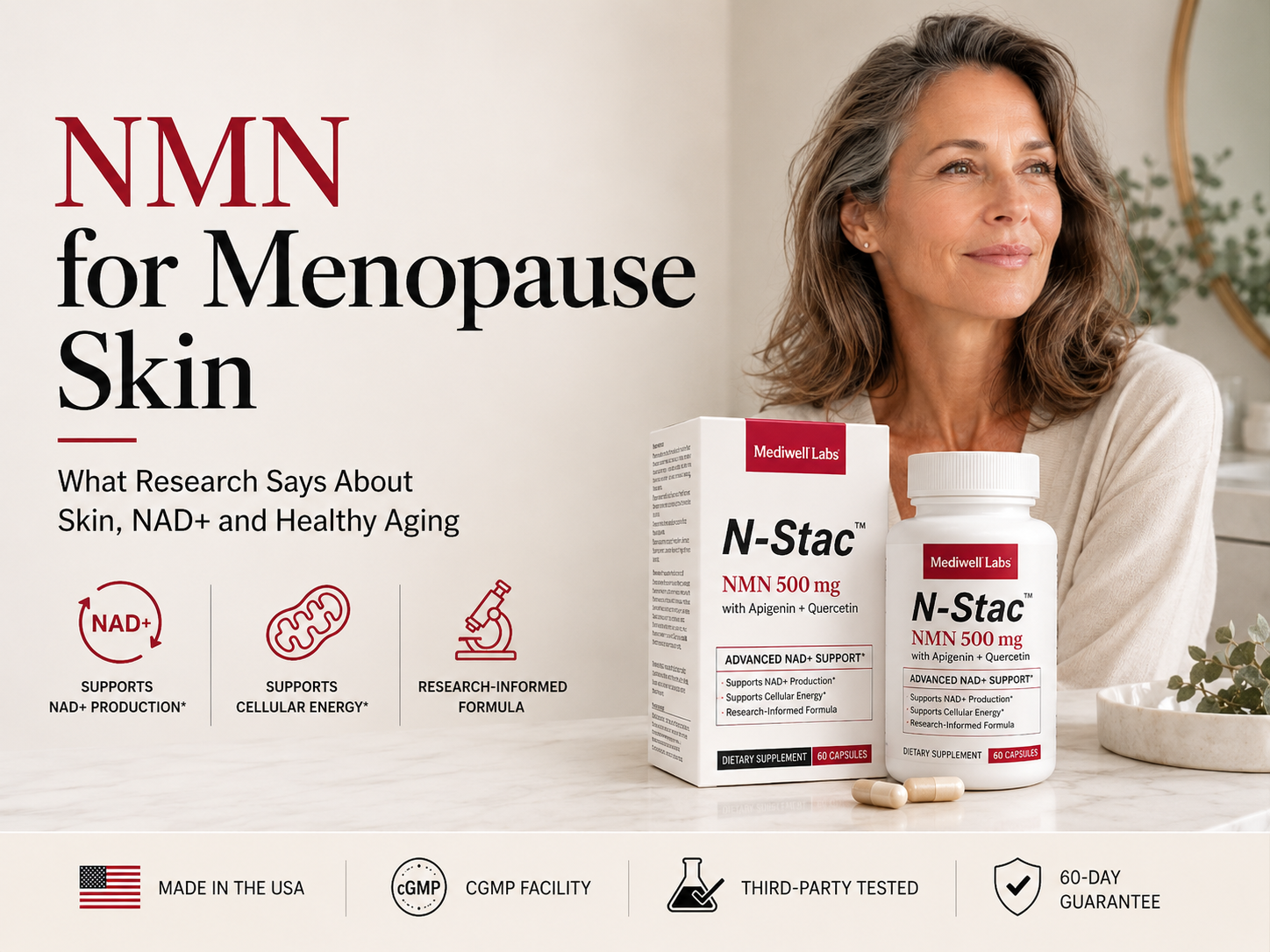
NMN and Menopause: Can It Support Aging Skin?
Menopause can change how the skin looks and feels. As estrogen levels decline, women may experience reduced collagen, dryness, lower elasticity, thinning skin, and slower wound healing.
These changes are well documented, but that does not mean NMN has been proven to reverse them.
NMN is a precursor the body can use to produce NAD+, a coenzyme involved in cellular energy metabolism and maintenance processes. Human studies show that oral NMN can increase certain NAD-related biomarkers, but research specifically examining NMN for menopausal skin remains limited.
This article explains what researchers currently know, what they do not yet know, and why NMN is being studied as part of broader healthy-aging strategies.
Menopause, Skin and Cellular Energy
Estrogen plays an important role in maintaining skin collagen, thickness, moisture, elasticity, and wound healing. As estrogen declines during menopause, these skin characteristics may change.
NAD+ is a separate but related area of healthy-aging research. It is involved in cellular energy metabolism and serves as a cofactor for enzymes connected with cellular maintenance.
NMN is a precursor the body can use to produce NAD+. Human trials suggest that oral NMN can increase NAD-related biomarkers, but researchers have not yet established that this directly restores collagen, firms menopausal skin, or reverses visible skin aging.
Why Researchers Are Interested in NMN
Researchers are interested in NMN because it may support several processes connected with healthy aging:
NAD+ production: NMN serves as a precursor the body can use to produce NAD+.
Cellular energy metabolism: NAD+ participates in reactions involved in converting nutrients into usable cellular energy.
Cellular maintenance pathways: NAD+ is required by enzymes such as sirtuins and PARPs, which are involved in cellular stress responses and maintenance processes.
What Does Research Say About NMN and Skin?
Research specifically examining NMN and menopausal skin is still limited.
One small exploratory study included healthy postmenopausal women who took 300 mg of NMN daily for eight weeks. Researchers reported changes in several biomarkers, including a reduction in skin autofluorescence associated with advanced glycation end products, or AGEs.
AGEs can accumulate in tissues and are associated with aging-related changes in proteins such as collagen. However, this small study does not prove that NMN firms the skin, rebuilds collagen, or prevents sagging.
The findings are interesting, but larger placebo-controlled trials are needed before clear conclusions can be made about NMN and visible skin outcomes.
The N-Stac™ Formulation Approach
N-Stac™ combines NMN with complementary ingredients as part of a multi-pathway formulation strategy.
NMN: Provides a precursor the body can use to support NAD+ production.
Apigenin: A naturally occurring flavonoid studied for its interaction with CD38-related pathways. CD38 is an enzyme involved in NAD+ metabolism.
Quercetin: Provides complementary flavonoid and antioxidant support.
BioPerine® Black Pepper Extract: Included to support the availability of selected ingredients in the formula.
This formulation does not mean N-Stac™ has been clinically proven to treat menopause or reverse skin aging. It reflects a broader approach to NAD+ support than using NMN alone.
Learn More About N-Stac™
Explore the full formula, ingredient amounts, testing information, customer reviews, and 60-day satisfaction guarantee.
Explore N-Stac™
 Does NMN Treat Menopause Symptoms?
NMN is not hormone replacement therapy and has not been proven to treat hot flashes, night sweats, vaginal dryness, mood changes, insomnia, or other menopause symptoms.
Research involving postmenopausal women has examined metabolic and biomarker outcomes, but that is not the same as demonstrating relief from menopause symptoms.
Women seeking treatment for menopause symptoms should discuss evidence-based options with a qualified healthcare professional.
The Bottom Line
Menopause can affect collagen, hydration, elasticity, skin thickness, and wound healing. NMN supports NAD+ production and has shown biological activity in human studies, but research specifically examining visible skin benefits in postmenopausal women remains limited.
One small exploratory study reported changes in a skin-related AGE measurement, but this does not prove that NMN firms the skin, rebuilds collagen, or reverses sagging.
N-Stac™ provides a transparent, multi-ingredient approach to NAD+ support. It should be viewed as a healthy-aging supplement—not as a treatment for menopause or a replacement for medical or dermatologic care.
References
- Raine-Fenning, N. J., Brincat, M. P., & Muscat-Baron, Y. “Skin aging and menopause: implications for treatment.” American Journal of Clinical Dermatology, 2003.
This review discusses menopause-related changes in collagen, elasticity, hydration, skin strength, and dermal structure. - Calleja-Agius, J., Brincat, M., & Borg, M. “The effect of menopause on the skin and other connective tissues.” Gynecological Endocrinology, 2012.
This review covers the effects of menopause and declining estrogen on collagen content, dermal thickness, elasticity, dryness, and wound healing. - Morita, M., et al. “Effects of oral nicotinamide mononucleotide supplementation on clinical parameters and nicotinamide metabolite levels in healthy middle-aged Japanese women.” Glycative Stress Research, 2022.
This small exploratory study evaluated 300 mg of NMN daily for eight weeks in postmenopausal women and reported changes in measures including skin autofluorescence associated with advanced glycation end products. - Yi, L., et al. “The efficacy and safety of β-nicotinamide mononucleotide supplementation in healthy middle-aged adults: a randomized, multicenter, double-blind, placebo-controlled, parallel-group, dose-dependent clinical trial.” GeroScience, 2023.
Participants received 300 mg, 600 mg, or 900 mg of NMN daily for 60 days. The study reported increased blood NAD concentrations and generally good short-term tolerability. - Yoshino, M., et al. “Nicotinamide mononucleotide increases muscle insulin sensitivity in prediabetic women.” Science, 2021.
This randomized trial studied 250 mg of NMN daily for 10 weeks in postmenopausal women with prediabetes. The outcome concerned muscle insulin sensitivity, not skin firmness or menopause symptom relief. - Song, Q., et al. “The safety and antiaging effects of nicotinamide mononucleotide in human clinical trials: an update.” Advances in Nutrition, 2023.
This review summarizes available human NMN trials and emphasizes that many proposed anti-aging benefits still rely largely on laboratory or animal evidence.

Leave a comment
This site is protected by hCaptcha and the hCaptcha Privacy Policy and Terms of Service apply.