
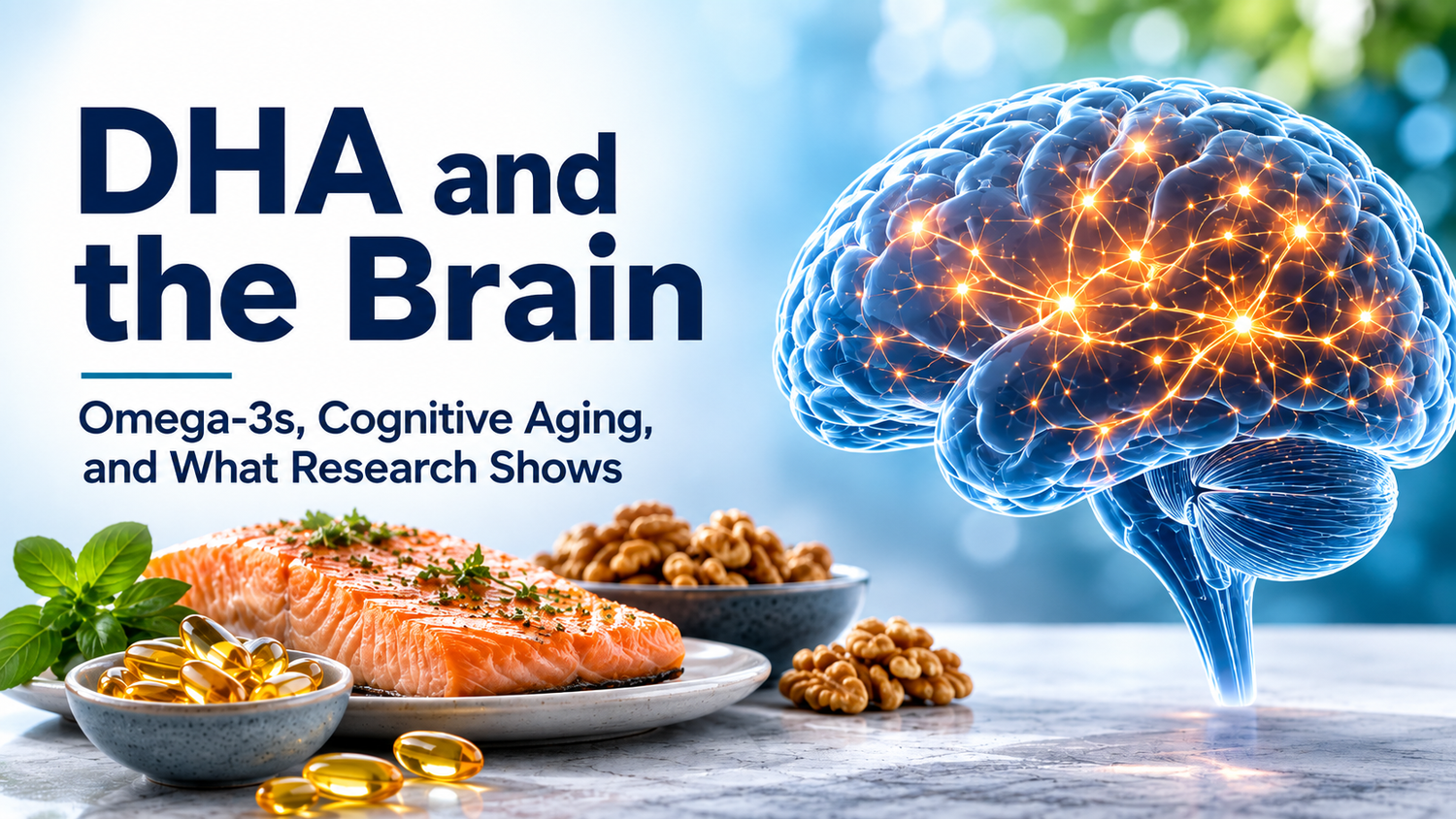
DHA and the Brain: What Role Does It Play?
DHA, or docosahexaenoic acid, is an omega-3 fatty acid found in high concentrations in the brain. It is an important component of neuronal cell membranes and contributes to membrane structure, fluidity and normal cell signaling.
Higher omega-3 intake has been associated with brain and cardiovascular health, but supplementation studies have produced mixed results. Some trials and reviews report benefits in certain populations, while others find little or no measurable improvement in cognition.
Cere-NAC does not contain DHA or replace fish oil. Instead, it provides nutrients selected to support antioxidant defenses, neurotransmitter-related pathways, cell membranes and cellular energy. This article explains where the two approaches may complement one another—and where the evidence remains uncertain.
What Does DHA Do in the Brain?
DHA is incorporated into the phospholipids that make up brain-cell membranes. Its structure helps membranes remain flexible, which can influence receptor activity, signaling and communication between cells.
DHA also serves as a precursor for specialized lipid mediators involved in the body’s resolution of inflammatory responses. This does not mean DHA simply switches off inflammation or repairs damaged neurons, but it helps explain why researchers continue to study omega-3 fatty acids in brain aging.
The brain uses specialized transport mechanisms to obtain DHA. One important pathway involves MFSD2A, which transports DHA in lysophosphatidylcholine form across the blood-brain barrier.
Does DHA Improve Memory or Prevent Cognitive Decline?
DHA plays an important structural role in the brain, but that does not mean DHA supplementation improves memory or prevents cognitive decline in every person.
Human studies have produced mixed results. Some research suggests possible benefits in certain groups, including people with low omega-3 intake or mild cognitive impairment. Other trials and reviews have found little or no measurable improvement in overall cognition.
The most accurate conclusion is that DHA is nutritionally important, while the effects of supplementation may depend on factors such as baseline omega-3 status, age, health, diet, dose and the outcome being measured.
How Cere-NAC Approaches Cognitive Support
Cere-NAC combines several categories of nutrients commonly used in cognitive-health formulas.
NAC and glycine
These amino-acid-related nutrients support the body’s production of glutathione, an important intracellular antioxidant.
Alpha GPC and citicoline
These ingredients provide sources of choline, which the body uses in phospholipid metabolism and acetylcholine production. They are included to support memory- and attention-related pathways.
Alpha lipoic acid and acetyl L-carnitine
These nutrients participate in cellular energy and antioxidant-related processes. Their inclusion reflects a nutritional support strategy.
Phosphatidylserine
Phosphatidylserine is a phospholipid found in cell membranes and is commonly included in cognitive-support supplements.
This combination is designed to support several areas of cognitive wellness.
B Vitamins, Homocysteine and Cognitive Aging
Vitamin B6, folate and vitamin B12 participate in pathways that help regulate homocysteine metabolism.
Elevated homocysteine has been associated with cognitive decline, vascular disease and brain atrophy in observational research. However, an association does not prove that homocysteine directly causes every case of cognitive decline.
B-vitamin supplementation can lower homocysteine levels. However, lowering homocysteine has not consistently been shown to prevent dementia or improve cognition in every population.
What the VITACOG Study Suggests
A secondary analysis of the VITACOG trial found that B-vitamin treatment was associated with slower brain atrophy primarily among participants who had higher baseline omega-3 fatty-acid levels.
This finding suggests that nutritional status may influence how people respond to B-vitamin supplementation. However, it does not prove that combining omega-3 supplements with B vitamins will prevent dementia, reverse cognitive decline or produce the same benefit in healthy adults.
The Bottom Line
DHA is an important structural component of brain-cell membranes and remains an active area of research in cognitive aging. However, omega-3 supplementation has not produced consistent cognitive benefits across all human trials. Some people and populations may benefit more than others.
Cere-NAC approaches cognitive support differently by providing nutrients connected with antioxidant defenses, choline metabolism, cell membranes and cellular energy.
People taking anticoagulants, managing a neurological condition or using multiple supplements should discuss omega-3 and nootropic supplementation with a qualified healthcare professional.
Learn More About Cere-NAC
Cere-NAC combines NAC, glycine, choline-related nutrients, phosphatidylserine, antioxidant-support ingredients and B vitamins in one fully disclosed cognitive-support formula.
Explore Cere-NAC

References
- Wong, B. H., & Silver, D. L. “Mfsd2a: A Physiologically Important Lysolipid Transporter in the Brain and Eye.” Advances in Experimental Medicine and Biology, 2020;1276:223–234.
https://pubmed.ncbi.nlm.nih.gov/32705603/
This review explains how MFSD2A transports DHA in lysophosphatidylcholine form across the blood-brain barrier. - Welty, F. K. “Omega-3 Fatty Acids and Cognitive Function.” Current Opinion in Lipidology, 2023.
https://pubmed.ncbi.nlm.nih.gov/36637075/
This review summarizes the mixed findings from human studies examining omega-3 fatty acids, cognitive decline and dementia risk. - Alex, A., Abbott, K. A., McEvoy, M., Schofield, P. W., & Garg, M. L. “Long-Chain Omega-3 Polyunsaturated Fatty Acids and Cognitive Decline in Non-Demented Adults: A Systematic Review and Meta-Analysis.” Nutrition Reviews, 2020;78(7):563–578.
https://pubmed.ncbi.nlm.nih.gov/31841161/
This analysis found no clear improvement in overall cognitive function, although a mild memory benefit was reported in some non-demented older adults. - Ajabnoor, S., et al. “Omega-3, Omega-6, and Polyunsaturated Fat for Cognition: Systematic Review and Meta-Analysis of Randomized Trials.” Journal of the American Medical Directors Association, 2020;21(10):1439–1450.e21.
https://pubmed.ncbi.nlm.nih.gov/32305302/
This large review found little or no effect of long-chain omega-3 supplementation on new cognitive impairment or overall cognition. - Jernerén, F., et al. “Brain Atrophy in Cognitively Impaired Elderly: The Importance of Long-Chain Omega-3 Fatty Acids and B Vitamin Status in a Randomized Controlled Trial.” American Journal of Clinical Nutrition, 2015;102(1):215–221.
https://pubmed.ncbi.nlm.nih.gov/25877495/
This secondary VITACOG analysis found that the effect of B-vitamin treatment on brain atrophy differed according to participants’ baseline omega-3 status. - Smith, A. D., et al. “Homocysteine-Lowering by B Vitamins Slows the Rate of Accelerated Brain Atrophy in Mild Cognitive Impairment: A Randomized Controlled Trial.” PLoS ONE, 2010;5(9):e12244.
https://pubmed.ncbi.nlm.nih.gov/20838622/
This VITACOG trial examined high-dose B vitamins, homocysteine and brain atrophy in older adults with mild cognitive impairment. - Dodd, S., Dean, O., Copolov, D. L., Malhi, G. S., & Berk, M. “N-Acetylcysteine for Antioxidant Therapy: Pharmacology and Clinical Utility.” Expert Opinion on Biological Therapy, 2008;8(12):1955–1962.
https://pubmed.ncbi.nlm.nih.gov/18990082/
This review discusses NAC as a glutathione precursor and evaluates its pharmacology, tolerability and clinical evidence. - Deepmala, Slattery, J., Kumar, N., et al. “Clinical Trials of N-Acetylcysteine in Psychiatry and Neurology: A Systematic Review.” Neuroscience & Biobehavioral Reviews, 2015;55:294–321.
https://pubmed.ncbi.nlm.nih.gov/25957927/
This systematic review evaluates NAC research across neurological and psychiatric conditions while highlighting the limitations of the available evidence

Leave a comment
This site is protected by hCaptcha and the hCaptcha Privacy Policy and Terms of Service apply.