
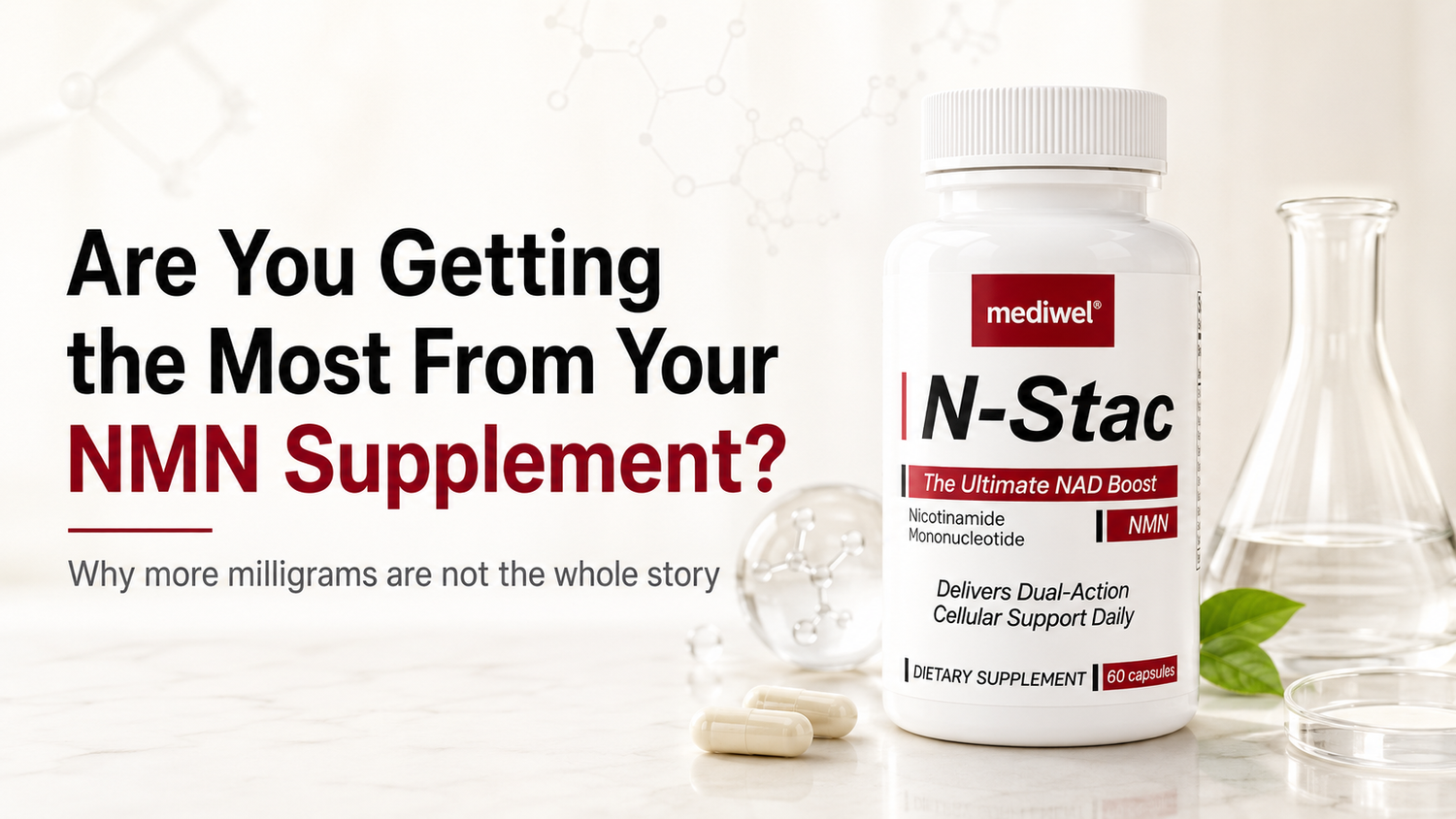
If you’ve been comparing NMN supplements, you’ve probably noticed that many products compete on one thing: the number of milligrams in each serving.
It's easy to assume that more NMN automatically means a better supplement.
But dosage is only one part of the NAD+ story.
NMN, or nicotinamide mononucleotide, is a precursor the body can use to produce NAD+, a coenzyme involved in cellular energy metabolism and other essential cellular processes.
Studies show that oral NMN can increase blood NAD-related levels. Researchers are also studying enzymes involved in NAD+ metabolism, including CD38. This has created interest in formulas that combine NMN with complementary ingredients rather than focusing on NMN dosage alone.
So the better question is not simply:
“How much NMN am I taking?”
It's:
“Am I getting the most from the formula I chose?”
What Is NMN and How Does It Support NAD+?
NMN is a naturally occurring molecule involved in the body’s production of NAD+.
NAD+ participates in several important biological processes, including:
- Cellular energy metabolism
- Redox reactions
- Cellular signaling
- Enzyme activity related to cellular maintenance
NAD+ metabolism can change with age, although the degree of change varies by tissue, health status, and how NAD+ is measured. NMN provides one of the precursors the body can use to produce NAD+.
Several human trials have shown that oral NMN supplementation can increase blood NAD+ or related metabolites. This suggests that NMN is biologically active after oral supplementation.
What it does not mean is that everyone taking NMN will experience the same noticeable changes in energy, focus, performance, or healthy aging.
Is More NMN Always Better?
Not necessarily. NMN studies have evaluated a range of daily doses. For example, one randomized 60-day trial evaluated:
- 300 mg per day
- 600 mg per day
- 900 mg per day
Researchers observed increases in blood NAD concentrations across the NMN groups, and the doses studied were generally well tolerated over the study period.
Other studies have evaluated amounts such as 250 mg per day over several weeks or months. This tells us that researchers have explored NMN across a broad dosage range.
What current research has not established is that:
900 mg is automatically better than 500 mg, or that 500 mg is automatically better than 250 mg for every person.
A larger number on the front of the bottle may look impressive, but dosage alone does not tell you everything about the supplement.
Formula transparency, testing, ingredient quality, and the rationale behind the complete formulation also matter.
What Does CD38 Have to Do With NAD+?
CD38 is an enzyme involved in NAD+ metabolism. Research suggests that CD38 activity can contribute to NAD+ consumption. Researchers have also investigated whether changes in CD38 activity may be involved in age-related changes in NAD+ availability.
This has made CD38 an interesting area of healthy-aging research. NMN provides a precursor for NAD+ production, while CD38 is one of several enzymes involved in how NAD+ is used and metabolized.
Understanding both sides of the process is one reason researchers are interested in approaches that look beyond precursor supplementation alone.
What Research Says About Apigenin and Quercetin
Apigenin and quercetin are naturally occurring plant flavonoids. In one frequently cited study, researchers found that apigenin and quercetin inhibited CD38 activity under experimental conditions. Apigenin also increased NAD+ levels in mice in the same study.
That research helps explain why apigenin and quercetin have attracted attention in NAD+ formulation strategies.
Why N-Stac™ Uses a Multi-Ingredient Approach
N-Stac™ was designed around the idea that NAD+ support does not have to focus on NMN dosage alone. Each two-capsule serving provides:
500 mg NMN
NMN provides a precursor the body can use to support NAD+ production.
150 mg Apigenin + 100 mg Quercetin
These plant flavonoids have been studied for their interaction with CD38-related and other cellular pathways. Their inclusion reflects a broader formulation strategy rather than a claim that they have been clinically proven to preserve NAD+ in people taking N-Stac™.
10 mg BioPerine® Black Pepper Extract
BioPerine® is included to support the availability of selected ingredients in the formula.
Together, these ingredients create a multi-ingredient approach to daily NAD+ support.
N-Stac™ also fully discloses the amount of each active ingredient, so you know exactly what is included in every serving.
No proprietary blends. No hidden dosages.
What Should You Look for in an NMN Supplement?
When comparing NMN supplements, do not look only at the number printed on the front of the bottle. Look at the complete product.
Fully Disclosed Dosages
You should be able to see exactly how much of each active ingredient you are getting.
Avoid formulas that hide important ingredient amounts inside proprietary blends.
Third-Party Testing
Independent testing can provide additional transparency around product quality.
Certificate of Analysis
A Certificate of Analysis, or COA, gives consumers another way to review available testing information.
cGMP Manufacturing
Look for supplements produced in facilities that follow current Good Manufacturing Practices.
A Practical Daily Serving
A supplement only works as part of your routine if the serving is realistic enough to take consistently.
Is Your NMN Supplement Being Wasted?
That is probably the wrong way to think about it. Studies demonstrate that oral NMN can increase NAD-related biomarkers, which means NMN is not simply passing through the body unused.
A better question is:
Does the supplement provide a transparent, thoughtfully designed formula that fits what I am looking for?
For some people, that may mean choosing a straightforward NMN-only product.
Others may prefer a formula that combines NMN with complementary ingredients.
Neither approach should be judged solely by the largest milligram number on the label.
Look Beyond the Milligrams
Want to see exactly what is inside N-Stac™?
Explore the complete formula, ingredient amounts, testing information, Certificate of Analysis, customer reviews, and 60-day satisfaction guarantee.
Explore N-Stac™
Use code TRY35 to save 35% on your first bottle.
References
- Yi, L., et al. “The efficacy and safety of β-nicotinamide mononucleotide supplementation in healthy middle-aged adults: a randomized, multicenter, double-blind, placebo-controlled, parallel-group, dose-dependent clinical trial.” GeroScience, 2023.
https://pubmed.ncbi.nlm.nih.gov/36482258/ - Yoshino, M., et al. “Nicotinamide mononucleotide increases muscle insulin sensitivity in prediabetic women.” Science, 2021.
https://pubmed.ncbi.nlm.nih.gov/33888596/ - Escande, C., et al. “Flavonoid apigenin is an inhibitor of the NAD+ase CD38: implications for cellular NAD+ metabolism, protein acetylation, and treatment of metabolic syndrome.” Diabetes, 2013.
https://pubmed.ncbi.nlm.nih.gov/23172919/ - Camacho-Pereira, J., et al. “CD38 Dictates Age-Related NAD Decline and Mitochondrial Dysfunction through an SIRT3-Dependent Mechanism.” Cell Metabolism, 2016.
https://pubmed.ncbi.nlm.nih.gov/27304511/ - Igarashi, M., et al. “Chronic nicotinamide mononucleotide supplementation elevates blood nicotinamide adenine dinucleotide levels and alters muscle function in healthy older men.” NPJ Aging, 2022.
https://pubmed.ncbi.nlm.nih.gov/35927255/ - Morifuji, M., et al. “Ingestion of β-nicotinamide mononucleotide increased blood NAD levels and affected physical function and sleep in older adults.” 2024.
https://pubmed.ncbi.nlm.nih.gov/38789831/ - Okabe, K., et al. “Oral Administration of Nicotinamide Mononucleotide Is Safe and Efficiently Increases Blood Nicotinamide Adenine Dinucleotide Levels in Healthy Subjects.” 2022.
https://pubmed.ncbi.nlm.nih.gov/35479740/

Leave a comment
This site is protected by hCaptcha and the hCaptcha Privacy Policy and Terms of Service apply.