
The CD38 Problem and How to Solve It
Executive Summary
The global NMN supplement market has exploded, with hundreds of brands competing primarily on dosage and price. However, most consumers—and even most supplement manufacturers—are unaware of a critical scientific reality: without CD38 inhibition, much of the NMN you consume is degraded before it can raise NAD+ levels effectively.
This white paper examines the role of CD38 (the primary NAD+-consuming enzyme), explains why standalone NMN supplementation has inherent limitations, and presents the scientific rationale for combining NMN with CD38 inhibitors like apigenin and quercetin.
The NAD+ Decline: Understanding the Problem
Nicotinamide adenine dinucleotide (NAD+) is a coenzyme present in every cell of your body. It's essential for energy metabolism, DNA repair, cellular signaling, and hundreds of enzymatic reactions that keep you alive and functioning optimally.
The problem? NAD+ levels decline by approximately 50% between ages 40 and 60. This decline has been linked to accelerated aging, reduced cellular energy, impaired DNA repair, and increased susceptibility to age-related diseases.
Enter NMN (nicotinamide mononucleotide)—a direct NAD+ precursor that has become one of the most popular anti-aging supplements on the market. The logic is straightforward: supplement with NMN, raise NAD+ levels, slow aging.
The Hidden Bottleneck: CD38
While the NAD+ supplementation industry has focused almost exclusively on increasing supply (through NMN, NR, or other precursors), most brands have ignored the equally critical issue of reducing demand—specifically, the enzymatic degradation of NAD+.
CD38 (cluster of differentiation 38) is the primary NAD+-consuming enzyme in mammals. It's not just a minor player; research shows that CD38 is responsible for degrading the vast majority of NAD+ in cells. Even more concerning: CD38 expression increases with age—the exact same time NAD+ levels are declining.
The Leaky Bucket Analogy
Imagine trying to fill a bucket with a large hole in the bottom. You can pour in more water (NMN), but if the hole keeps getting bigger (increasing CD38 activity with age), you're fighting an uphill battle. The scientifically sound approach is to both add more water and patch the hole.
The Scientific Evidence for CD38 Inhibition
Multiple peer-reviewed studies have demonstrated that inhibiting CD38 activity can significantly improve NAD+ levels:
Study 1: CD38 Knockout Mice
Research on mice with CD38 gene knockout showed dramatically higher NAD+ levels compared to normal mice—even without NAD+ precursor supplementation. This established CD38 as the dominant NAD+-degrading enzyme in vivo.
Study 2: Age-Related CD38 Increase
Studies in both animal models and human tissues have shown that CD38 expression and activity increase with age, particularly in immune cells and adipose tissue. This creates a vicious cycle: lower NAD+ and higher NAD+ degradation simultaneously.
Study 3: Natural CD38 Inhibitors
Research has identified several naturally occurring flavonoids that inhibit CD38 activity, with apigenin and quercetin emerging as the most promising candidates for supplementation due to their safety profiles and bioavailability.
Apigenin and Quercetin: Nature's CD38 Inhibitors
Apigenin
Apigenin is a natural flavonoid found in parsley, celery, and chamomile. Beyond its CD38-inhibiting properties, apigenin has demonstrated:
• Anti-inflammatory effects
• Antioxidant activity
• Neuroprotective properties
• Potential senolytic activity (removal of senescent cells)
Research suggests apigenin can reduce CD38 activity significantly, allowing NAD+ to accumulate rather than being rapidly degraded.
Quercetin
Quercetin is another well-studied flavonoid found in onions, apples, and berries. Like apigenin, quercetin inhibits CD38 while providing additional benefits:
• Cardiovascular support
• Anti-inflammatory and antioxidant effects
• Enhanced exercise performance and recovery
• Potential senolytic properties when combined with other compounds
The Synergistic Approach: NMN + CD38 Inhibitors
The rationale for combining NMN with CD38 inhibitors is based on addressing NAD+ metabolism from both sides:
1. Supply Side (NMN): Provides the raw material for NAD+ synthesis
2. Demand Side (Apigenin + Quercetin): Reduces the enzymatic breakdown of NAD+ by inhibiting CD38
This dual-mechanism approach theoretically allows for:
• Higher sustained NAD+ levels
• More efficient use of NMN supplementation
• Potentially lower effective doses of NMN needed
• Better long-term outcomes for NAD+-dependent processes
Why Most NMN Brands Miss the Mark
The current NMN market is characterized by:
Dosage Wars: Brands competing on who can cram the most NMN into a capsule (500mg, 750mg, 1000mg+) without addressing bioavailability or degradation
Price Racing: A race to the bottom on pricing, often at the expense of quality control, third-party testing, or formula optimization
Single-Ingredient Focus: Ignoring the broader NAD+ metabolism picture and the well-documented role of CD38
Lack of Scientific Sophistication: Marketing based on milligrams rather than mechanisms of action
The result? Consumers are taking high doses of NMN while their CD38 levels—especially if they're over 40—are working overtime to degrade the very NAD+ they're trying to increase.
Supplement Approach Comparison
|
Approach |
Mechanism |
Limitation |
|
NMN Only |
Increases NAD+ precursor availability |
CD38 rapidly degrades newly synthesized NAD+, especially in aging individuals |
|
High-Dose NMN (750-1000mg+) |
Attempts to overwhelm degradation through sheer volume |
Inefficient, expensive, and doesn't address root cause; potential diminishing returns |
|
NMN + CD38 Inhibitors |
Dual approach: increases supply AND reduces degradation |
Addresses both sides of NAD+ metabolism for optimal results |
The N-Stac™ Formula: Science-Based Synergy
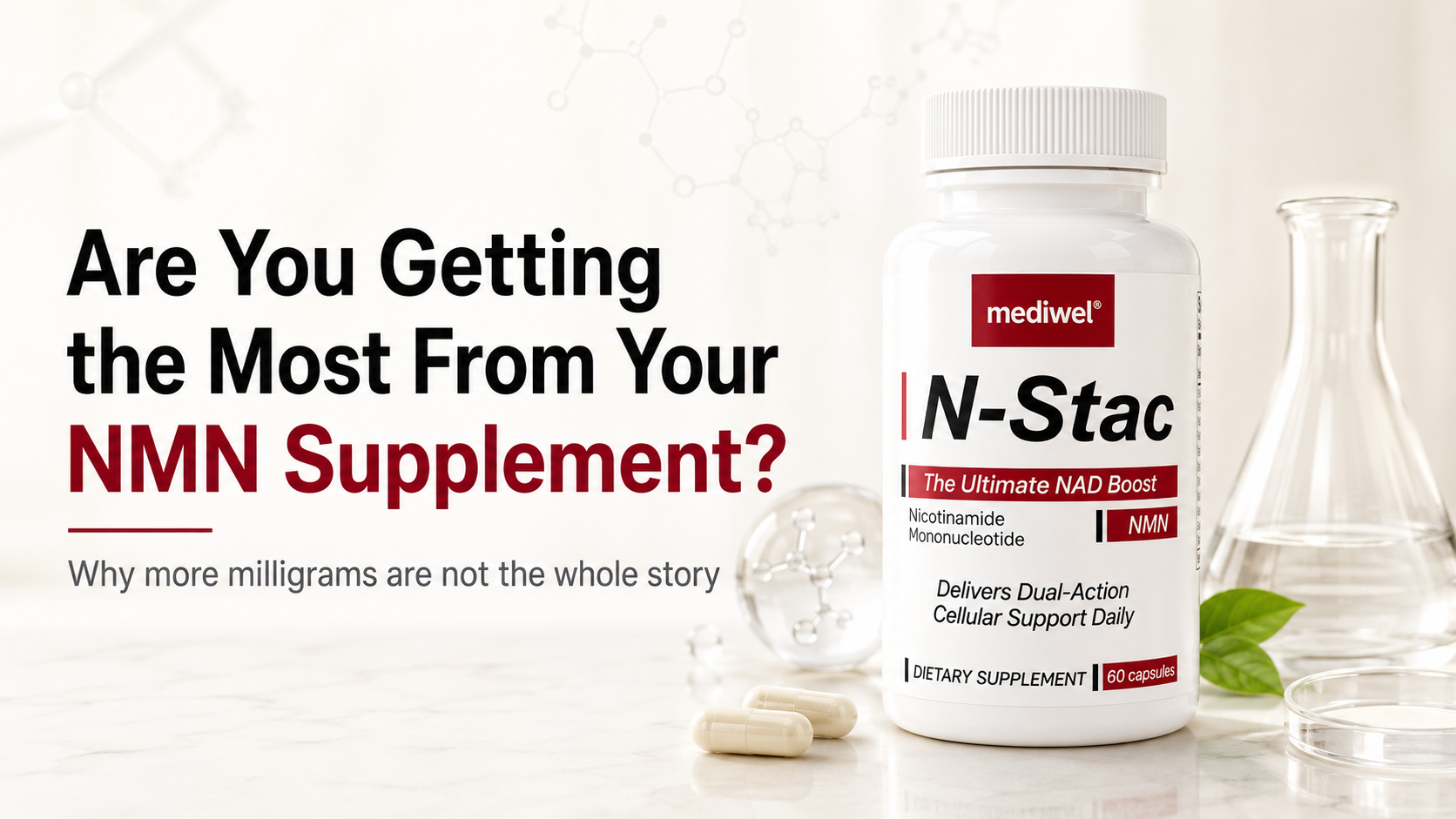
N-Stac was formulated based on current peer-reviewed research on NAD+ metabolism and CD38 inhibition. Each two-capsule serving provides:
• 500mg NMN – Clinical dose for NAD+ precursor support
• 150mg Apigenin – Primary CD38 inhibitor with additional neuroprotective benefits
• 100mg Quercetin – Secondary CD38 inhibitor with cardiovascular and anti-inflammatory support
Why These Dosages?
NMN (500mg): This dose has been used in multiple human clinical trials and represents the lower-middle range of effective dosing. When combined with CD38 inhibitors, the same NAD+ elevation may be achieved more efficiently than higher doses of NMN alone.
Apigenin (150mg): Research on apigenin supplementation typically uses doses ranging from 50-200mg. We selected 150mg to ensure meaningful CD38 inhibition while remaining well within safety parameters.
Quercetin (100mg): Quercetin is commonly supplemented at 500-1000mg for general health, but for CD38 inhibition purposes, lower doses have shown efficacy. The 100mg dose complements apigenin while providing additional antioxidant support.
Quality Assurance: Third-Party Testing
In a market flooded with untested or under-tested supplements, quality assurance is non-negotiable. N-Stac is:
• Third-party tested for purity and potency
• Accompanied by Certificate of Analysis (COA) available upon request
• Manufactured in GMP-certified facilities
• Free from unnecessary fillers and artificial ingredients
This commitment to transparency and quality ensures that what's on the label is what's in the bottle—something that cannot be taken for granted in the supplement industry.
A Smarter Approach to NAD+ Optimization
The science is clear: NAD+ decline is a central feature of aging, and supplementation with NAD+ precursors like NMN can help. However, the equally clear reality is that increasing supply without addressing demand is an incomplete strategy.
CD38-mediated NAD+ degradation increases with age precisely when NAD+ levels are falling. Ignoring this enzymatic bottleneck means fighting an uphill battle—one that can only be partially won with higher doses and higher costs.
N-Stac addresses NAD+ metabolism from both angles: providing clinically relevant doses of NMN while simultaneously reducing NAD+ degradation through apigenin and quercetin. This synergistic, science-based approach represents the next generation of NAD+ supplementation.
The question isn't whether to supplement with NMN. The question is whether you're doing it intelligently.
References & Further Reading
1. Camacho-Pereira J, et al. CD38 Dictates Age-Related NAD Decline and Mitochondrial Dysfunction through an SIRT3-Dependent Mechanism. Cell Metabolism. 2016.
2. Chini CCS, et al. CD38 ecto-enzyme in immune cells is induced during aging and regulates NAD+ and NMN levels. Nature Metabolism. 2020.
3. Escande C, et al. Flavonoid apigenin is an inhibitor of the NAD+ ase CD38. Implications for cellular NAD+ metabolism. FASEB Journal. 2013.
4. Yoshino J, et al. NAD+ Intermediates: The Biology and Therapeutic Potential of NMN and NR. Cell Metabolism. 2018.
5. Rajman L, et al. Therapeutic Potential of NAD-Boosting Molecules: The In Vivo Evidence. Cell Metabolism. 2018.


Leave a comment
This site is protected by hCaptcha and the hCaptcha Privacy Policy and Terms of Service apply.